


The Culture of Rice in Japan: A Closer Look at Japan's Beautiful Rice Planting Festivals
- Lori Tsugawa

- 6 days ago
- 4 min read
There’s a certain quiet that settles over Japan in June. The rainy season rolls in, the paddies fill with water, and all at once the countryside turns a deep, mirror-bright green. This is when communities across the country gather to plant rice, much as they have for centuries. These gatherings, known broadly as otaue, are so much more than farm work set to music. To really feel what they’re about, it helps to look at where they come from, what the traditions mean, and why they still hold such a special place in everyday life.

Otue’s Origin
The story of otaue goes a long way back. Planting rice by hand was slow, aching work, so villagers sang as they went, keeping a shared rhythm that made the day lighter and the rows straighter. Little by little, those planting songs folded into prayers for a good harvest, and what started as plain fieldwork grew into something sacred: a Shinto ceremony in its own right.

You can see this beautifully at the Otaue ritual held at Sumiyoshi Taisha Shrine in Osaka every June 14th. The tradition is said to reach all the way back to the year 211, when a special field was set aside to grow rice as an offering to the shrine’s deity. Today it’s recognized as an Important Intangible Cultural Folk Asset, and watching it feels a little like stepping back in time.
Other towns have lovingly kept their own versions going. In Hiroshima, the Mibu no Hana Taue, held on the first Sunday of June, was added to UNESCO’s list of Intangible Cultural Heritage of Humanity in 2011. Further south in Kumamoto, the Arao Rice Planting Festival quietly faded after the war before being revived in 1973. It’s a good reminder that these traditions only survive because each new generation decides they’re worth keeping.
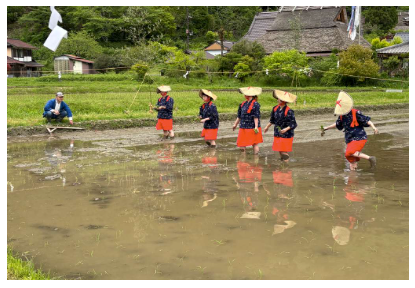
One of the prettiest of all unfolds a little earlier in the year. On the second Sunday of May, the Miyama Rice Planting Festival takes place in the thatched-roof village of Kita, tucked away in the mountains of Kyoto Prefecture. After a Shinto rite at Chii Hachiman Shrine to pray for a good harvest, saotome, young women in sedge hats and dressed in kasuri kimono wade into the paddy and plant the seedlings against a backdrop of old farmhouses that looks like a scene from centuries past. It’s a gentle, postcard-perfect glimpse of the Japanese countryside at its most timeless.

The Meaning Behind the Planting
Once you know what to look for, you realize that almost everything at a rice planting festival has a meaning. At the very center is Ta-no-Kami, which simply means “the deity of the rice fields.” This kami is believed to watch over the crop and bless it with a good harvest, and is tied to water, rain, the mountains, and even the spirits of ancestors. Honoring Ta-no-Kami is really the whole reason these festivals exist.

The women who set the seedlings into the mud are known as saotome. They’re a symbol all their own. Dressed in their very best, with deep indigo robes, red sashes, white head cloths, and fresh sedge hats, they take on a sacred role as they work. Those fine clothes are a clear sign that this is no ordinary day in the fields, but a special and important one.
And it doesn’t stop there. The decorated oxen, the steady beat of the drums, the bright call of the flutes, and the planting songs all have their part to play. The music and dancing are meant to bring a generous autumn harvest from the earth, while the beautifully adorned cattle that plow the paddy mark the field as something set apart.
Why It Still Matters
In Japan, rice has never been just something to eat. It represents life. Planting rice becomes a way of expressing life’s continuation into the next generation, and beyond.
Plenty of local farms open their gates and invite visitors to join in. Fukusuke Farm in Sanda City, Hyogo, for example, runs hands-on planting days where you can sink your own hands into the paddy and then share a traditional farm meal afterward. At the Arao festival, local schoolchildren and even Kumamon, Kumamoto’s famous bear mascot, step into the field too, a lovely sign of how these traditions pull whole communities together across generations.
In the end, that is what rice planting festivals are really about. They quietly remind everyone that the good things take patience, care, and a lot of hands working together. Those are values that have shaped Japanese culture for well over a thousand years, and each June, they take root all over again.
References
Haga, H. (2026, May 6). Rice-planting festivals: Folk traditions centering on the rice paddy deity. Nippon.com. https://www.nippon.com/en/guide-to-japan/gu019019/
Japan National Tourism Organization. (n.d.). Otaue rice planting festival. Travel Japan. Retrieved June 2, 2026, from https://www.japan.travel/en/spot/25/
Japanese Wiki Corpus. (n.d.). Tanokami.
Retrieved June 2, 2026, from https://www.japanesewiki.com/Shinto/Tanokami.html
Ta-no-Kami. (n.d.). In Wikipedia.
Retrieved June 2, 2026, from https://en.wikipedia.org/wiki/Ta-no-Kami
UNESCO. (n.d.). Mibu no Hana Taue, ritual of transplanting rice in Mibu, Hiroshima. Intangible Cultural Heritage.
Retrieved June 2, 2026, from https://ich.unesco.org/en/RL/mibu-no-hana-taue-ritual-of-transplanting-rice-in-mibu-hiroshima-00411


Comments