


Mieko Kamiya - The Mother of Ikigai and What Makes Life Worth Living

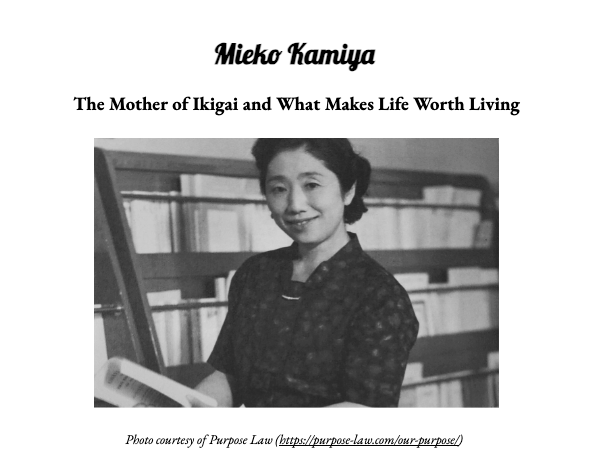
When we talk about purpose and fulfillment, the concept of ikigai often comes up. But behind this widely shared idea is a woman whose life and work gave it depth and soul. Mieko Kamiya was not simply defining a concept. She was living and studying it through real human experience.
Her story is not just history. It is a guide for anyone trying to understand what makes life truly meaningful.
A Life Rooted in Compassion
Mieko Kamiya was born in 1914 into a well-educated and internationally-exposed family. She spent part of her early years abroad, which gave her a broader perspective on culture and human behavior.
She later pursued medicine and specialized in psychiatry, but what set her apart was not just her profession. It was where she chose to apply it.
Kamiya worked closely with patients suffering from Hansen’s Disease (Leprosy), a condition that led to extreme social isolation in Japan at the time. These individuals were often removed from society and forced to live in sanatoriums, cut off from their families and normal life.

Instead of seeing them as outcasts, she listened to them. She studied their emotional and psychological experiences. She wanted to understand how they found reasons to keep living despite their circumstances.
This work became the foundation of her most important insights.
Ikigai: More Than Just a Trend
Kamiya’s exploration of ikigai focused on what truly gives life meaning.
In her book On the Meaning of Life (Ikigai ni Tsuite), she described ikigai as the feeling that life is worth living. It is not limited to success, passion, or productivity. It is something much more personal.

To further explain this, Kamiya viewed ikigai as something made up of multiple layers, often visualized as Kamiya’s Flower.
Each petal represents a different source of meaning. Rather than relying on one big purpose, a meaningful life is built through a combination of experiences, connections, and inner fulfillment.
These “petals” can include:
A sense of being alive
Personal growth and development
Future goals or direction
Emotional fulfillment
Relationships and connection
Contribution to others
What makes this concept powerful is that its meaning is multifaceted and therefore, not fragile. If one part of life fails, other “petals” still remain.
This reflects what Kamiya observed in her patients. Even in the most difficult conditions, people were still able to hold on to reasons for living.
This is why ikigai is not dependent on perfect circumstances. It exists even in limitations, and it grows through the many small things that make life feel a worthy venture.

In a time where people are constantly chasing success, validation, and external achievements, Kamiya’s work offers a grounding truth: contentment/happiness/meaning comes from within.
She shifts the focus inward.
Her message is especially relevant today because many people feel lost despite having more freedom and opportunity than ever. The pressure to “have it all figured out” often leads to burnout and disconnection.
Kamiya reminds us that meaning is not something you achieve once and keep forever. It is something you build continuously.
She also highlights that struggle does not disqualify you from living a meaningful life. In many cases, it deepens your understanding of it.
Her life and work leave us with insights that are both simple and powerful.
First, meaning is personal. There is no single formula for ikigai. What gives your life value may look completely different from someone else’s.
Second, difficult circumstances do not erase purpose. Even in pain or limitation, there are still ways to find reasons to keep going.
Third, connection matters. Many of Kamiya’s observations showed that relationships and a sense of belonging play a huge role in feeling that life is worth living.
Conclusion:
In the end, what this reminds us is that meaning isn’t something reserved for a certain kind of life. It’s something available to all of us, in ways that are often quieter and more personal than we expect.
It’s easy to think we need everything figured out before we can feel fulfilled. But the truth is, meaning doesn’t arrive all at once. It builds slowly through the small moments, the relationships we nurture, the challenges we move through, and the ways we choose to keep going.
What makes this idea so comforting is that life doesn’t have to be perfect to be meaningful. Even in uncertainty, even in struggle, there are still reasons to continue, to care, and to find value in being here.
Like Kamiya’s Flower, purpose is made of multiple parts, not a single entity or answer. It’s about allowing ourselves to create meaning as we go, piece by piece, day by day, in ways that feel true to who we are.
And that, more than anything, makes life feel a little more human and a lot more worth living.
References:
Honda, N. (2023). The life and suffering of Mieko Kamiya: As a truth-seeker and as a woman. Psychiatria et Neurologia Japonica, 125(3), 3–13
Ikigai Psychology. (n.d.). Ikigai. https://www.ikigaipsychology.com.au/ikigai
Ikigai Tribe. (n.d.). Ikigai ni tsuite. https://ikigaitribe.com/blogpost/ikigai-ni-tsuite/
Ikigai Tribe. (n.d.). Mieko Kamiya. https://ikigaitribe.com/ikigai/mieko-kamiya/
Ikigai Tribe. (n.d.). Podcast #82: Mieko Kamiya and the true meaning of ikigai. https://ikigaitribe.com/podcasts/podcast82/
Insight and Coaching. (n.d.). Mieko Kamiya. https://insightandcoaching.com/tag/mieko-kamiya/


Comments